Short, simple posts are the best way to keep your visitors up to date. An attention-grabbing introductory paragraph and brief, informative content will ensure your readers keep coming back.
Picture this: it's morning, you've got a warm cup of coffee in one hand and a watering wand in the other. As you water your squash and take in the sunrise, you notice bees buzzing everywhere; it turns out your caffeine buzz isn't the only one out here. Congratulations, you've most likely attracted the squash bee, widely regarded as one of the most important native floral specialists in the US. Don't be alarmed; these bees are quite docile, and it's very rare for them to sting humans.
To the untrained eye, squash bees are easy to mistake for honey bees. Look closer, though, and you'll notice they're fuzzier, chunkier, and have rounder faces. There are two species of squash bee found in North America: Peponapis pruinosa and Xenoglossa pruinosa. Of the two, the Eastern cucurbit bee (Peponapis pruinosa) is the more common.
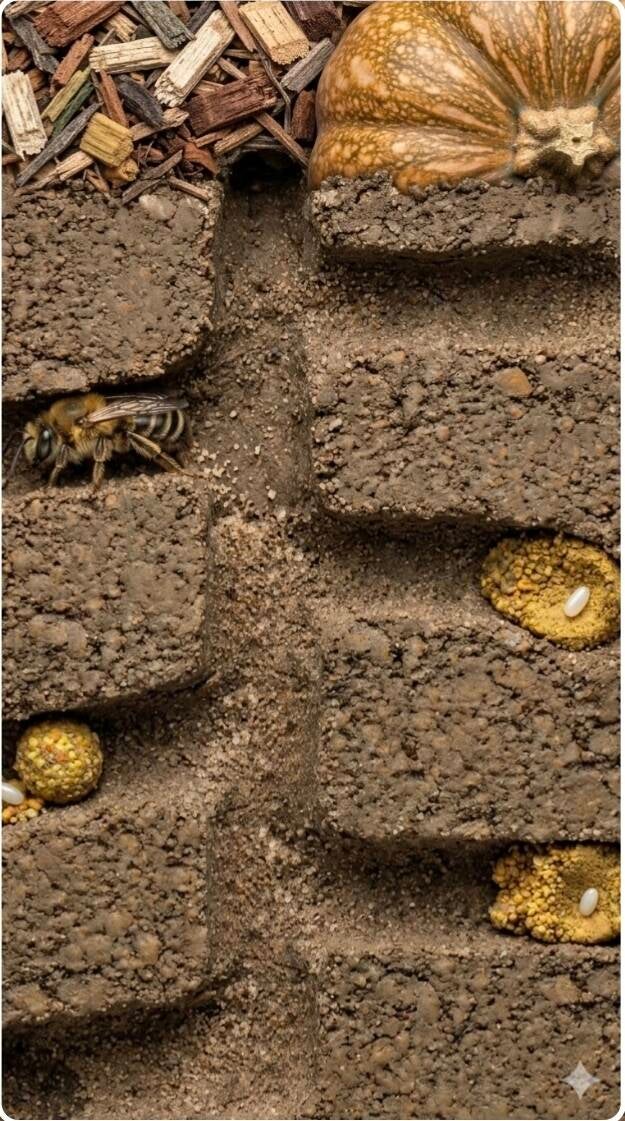
Unlike honey bees, squash bees are solitary and keep to themselves. They're also pollen specialists — known as oligoleges — for the genus Cucurbita, meaning squash, pumpkins, and gourds are essentially all they visit. Female squash bees dig vertical, tube-shaped nests about a foot into the soil, branching into horizontal chambers where they store pollen and lay their eggs.
Because of this underground nesting habit, squash bees can act as an indicator species for soil health, if they're nesting in your garden, that's a good sign your soil habitat is in decent shape. Farming practices play a role too: no-till gardens have been found to support squash bee densities roughly three times higher than tilled ones (Shuler et al., 2005).
Mulch is another piece of the puzzle. While there isn't yet strong research directly linking mulch to squash bee populations, it has been shown to produce healthier squash plants and higher pumpkin yields compared to bare soil (Splawski et al., 2014). Keeping your soil healthy benefits both your plants and your squash bees — happy bees, happy plants.
Squash bees — and for that matter, most wild bees — are in a mutual, symbiotic relationship with you, your garden's soil biology, and your plants. Underground nesting is common among bees: estimates range from 64% (Cane & Neff, 2011) to 83% (Harmon-Threatt, 2020) of bee species nesting below the soil surface. As female squash bees build their vertical nests, branching into horizontal chambers through the soil, that nest structure takes on its own role in the soil environment, increasing aeration and water infiltration. As the female brings in pollen for her larvae, both the unconsumed pollen and the bees' waste become a nutrient-dense underground cache — food for soil organisms and biota, which cycle those nutrients back to your plants, and the cycle continues.
Let's break down the benefits of squash bees in your garden, and why you want to increase their population:
- Garden sound and visual beauty
- Pollinate your squash, pumpkin, and gourd plants
- Increase soil aeration and nutrients
- Increase deep water infiltration
- Improve soil structure and feed your soil biology
So next time you reach for the tiller, maybe reach for the mulch instead. Your squash bees — and your pumpkin patch — will thank you.
References
Shuler, R. E., Roulston, T. H., & Farris, G. E. (2005). Farming practices influence wild pollinator populations on squash and pumpkin. Journal of Economic Entomology, 98(3), 790–795. https://doi.org/10.1603/0022-0493-98.3.790
Splawski, C. E., Regnier, E. E., Harrison, S. K., Goodell, K., Bennett, M. A., & Metzger, J. D. (2014). Mulch effects on floral resources and fruit production of squash, and on pollination and nesting by squash bees. HortTechnology, 24(5), 535–545. https://doi.org/10.21273/HORTTECH.24.5.535
Cane, J. H., & Neff, J. L. (2011). Predicted fates of ground-nesting bees in soil heated by wildfire: Thermal tolerances of life stages and a survey of nesting depths. Biological Conservation, 144, 2631–2636. https://www.sciencedirect.com/science/article/abs/pii/S0006320711002825
Harmon-Threatt, A. (2020). Influence of nesting characteristics on health of wild bee communities. Annual Review of Entomology, 65, 39–56. https://doi.org/10.1146/annurev-ento-011019-024955

Example of a Squash Bee underground nest